


The Forgotten Quarterback Who’s Making Seattle Dream
- Arnaud Dignocourt
- Feb 5
- 7 min read
After a disastrous start to his career, Sam Darnold was widely seen as unfit for the NFL. But over the past two seasons, he has reinvented himself, first in Minneapolis, then in Seattle. As he prepares to play in his first Super Bowl, the entire league has changed its perspective on him.

Drafted by the New York Jets with the third overall pick in 2018, Sam Darnold endured a difficult start to his career in the league. Quickly labeled a “bust,” he struggled to embody the hope of a long-awaited revival that Jets fans had been craving for years. But over the past two seasons, a very different player seems to have taken the field in the National Football League.
The Jets, a historically mediocre franchise
His time with the Jets? Largely forgettable in terms of success, yet memorable in how perfectly it reflected the mediocrity of the New York franchise. At first glance, Darnold appeared to be part of the problem: an interception-prone quarterback, careless with the ball when taking hits, and guilty of questionable reads in the passing game. But these flaws were already present in college, the Jets knew exactly what they were signing up for.
The real question lies with the franchise itself: Why was Sam Darnold never able to prove himself in New York?
To begin with, the Jets have long been viewed as an average, if not outright poor, organization. In 2025, the NFL Players Association (NFLPA) even ranked the Jets as the fourth-worst franchise to work for. Ownership has been reluctant to invest in facilities, players feel a lack of support, and the owner has reportedly vetoed certain trades based on players’ ratings in the American football video game Madden.
This environment is hardly conducive to player development. And Darnold is far from the only one to have paid the price: Zach Wilson and Geno Smith also failed to live up to expectations within the organization.
Same outcome in Charlotte
In an attempt to salvage something from a “failed” quarterback, the Jets sent Darnold to the Carolina Panthers in exchange for low-value draft picks. In Charlotte, the verdict is the same. He has to battle a redemption-seeking Baker Mayfield for the starting job and never truly gets the chance to relaunch his career.
Still, the first signs of change begin to appear. Upon his arrival, fans and analysts view him as a low-risk option, potentially an answer for a Panthers offense struggling to find efficiency and consistency. Overall, Sam Darnold’s stint in Carolina is far from flawless. His inconsistency seems chronic, but he already looks better than he did in New York, despite a fairly similar context. In hindsight, the media would later agree that this was the first step toward something much bigger.
Less pressure, a clearly defined role
The experience is short-lived, barely two seasons. Awkwardly oscillating between spot starter and high-end backup, Darnold is not re-signed by the Panthers. He becomes an unrestricted free agent and, in March 2023, signs with the San Francisco 49ers, who are gearing up for a Super Bowl run. Since the 49ers give up nothing to acquire him, the pressure is minimal and the role is clear: he will serve as Brock Purdy’s backup should his elbow once again become an issue.
“You know, we weren’t sure about Brock’s elbow at the time. I thought I might come in and start two or three games, depending on Brock’s situation.”
Sam Darnold, then backup quarterback for the 49ers
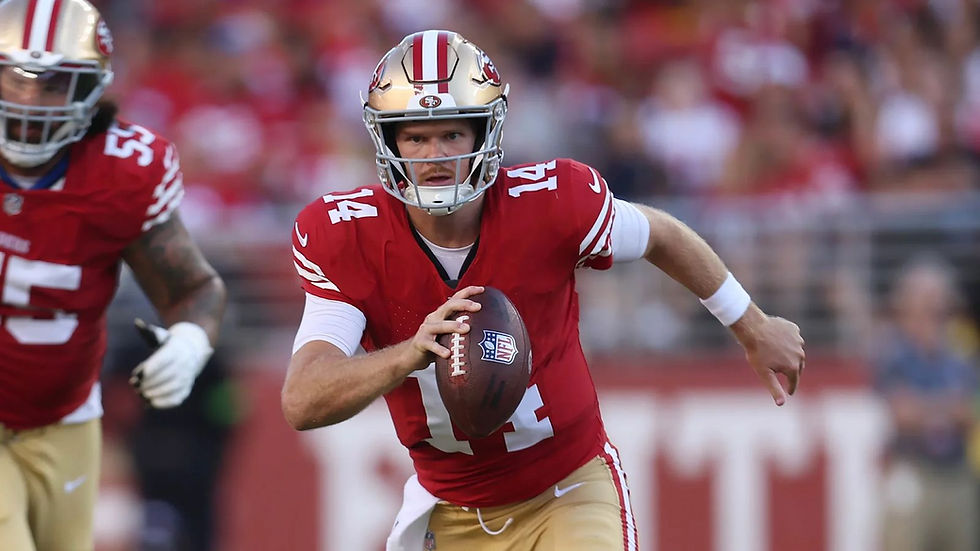
That season, he sees the field only a handful of times, mostly in meaningless situations: two touchdowns, fewer than 50 pass attempts, and very limited playing time. And yet, this stop in San Francisco reshapes Sam Darnold’s career in many ways. In a more patient environment, surrounded by elite teammates and freed from the pressure to succeed immediately, he grows. Quietly, he learns from Brock Purdy and under Kyle Shanahan’s guidance as well.
Being a backup on a franchise expected to contend for a Super Bowl is a far more comfortable position than being tasked with embodying the future of a floundering organization incapable of building a team around its quarterback.
In Minnesota, the stars finally align
San Francisco fall short in the Super Bowl, and Sam Darnold was never meant to be a long-term solution there. He heads to Minneapolis with the Vikings, determined to re-establish himself in the NFL as a reliable starter. To do so, he is set to compete with J.J. McCarthy, freshly drafted by the Vikings.
But in Minnesota, everything falls into place for Sam. McCarthy is injured during the preseason, and Darnold suddenly knows he will be the starting quarterback for the upcoming season. All he ever needed was a real opportunity. For the first time in his career, Sam Darnold takes control of an offense built to succeed. His offensive line gives him time in the pocket and allows the running game to be established consistently. As a result, the offense scores more, is better balanced, and far less predictable.
Darnold leads his unit into the Top 10 offenses of the season and guides the Vikings to a playoff berth. Despite a Wild Card loss to the Rams, the Vikings’ season is remembered above all for Sam Darnold’s level of play. He delivers the best campaign of his career, posts more than respectable statistics, and earns a Pro Bowl selection. He finally puts himself on the league’s radar, but questions remain: was this merely a one-hit wonder, a single flash of success without lasting confirmation?ù

Who is behind this small miracle in Minnesota? The answer may well lie with the Vikings’ coaching staff. Head coach Kevin O’Connell has built a reputation as a quarterback whisperer. Before arriving in Minneapolis, he was already behind several success stories at the position. Kirk Cousins, whom he later reunited with in Minnesota, first worked under O’Connell in Washington, where he earned his stripes as a full-time starter. O’Connell also played a key role in Jared Goff’s strong season with the Rams before his trade to Detroit in 2020, after what had been a painful 2019 campaign. One can also point to the transitional period in Minnesota, when the Vikings had to rotate multiple quarterbacks following Cousins’ injury: none became stars, but all found a functional role within O’Connell’s system.
Sam Darnold must prove himself
In Seattle, everything changes. When Sam Darnold is announced as a signing in the summer of 2025, while Geno Smith is sent to Las Vegas, doubts still linger. He arrives in Seattle amid a transition period that fans are still struggling to fully understand. Two years earlier, Russell Wilson, the quarterback who delivered a Super Bowl to the Seahawks, was traded away, and Pete Carroll was dismissed as head coach. The man taking over is Mike Macdonald.
And Macdonald works wonders with Geno Smith at the helm. He improves the Seahawks’ record from 9–8 over the previous two seasons to 10–7. That ten-win mark may be symbolic, but it matters. Smith’s statistics are similar, yet the improvement shows that the new system and coaching staff managed to extract the maximum from the roster at hand. Hope blossoms from that season. A slow rebuild was expected, but Mike Macdonald is not the patient type. Without rushing the process, he drafts young players at positions of need, trades away those who don’t fit his plans, and steadily solidifies his vision for the Seahawks.
Sam Darnold, then, must prove himself, both to win over the city and to secure a long-term place on the roster. The Seahawks’ front office has no desire to overpay a mediocre quarterback in the long run, so they offer him a clear-cut contract: three years, $100 million, with built-in protections for the team.
2025 is fully guaranteed: $37.5 million. This includes his signing bonus and base salary, paid regardless (as long as he remains healthy).
2026 is partially guaranteed: $27.5 million, with $17.5 million guaranteed for injury and at signing. The remainder becomes guaranteed after Super Bowl LX (played at the end of the 2025 season) if he is still on the roster. In all likelihood, he will earn it—since he is set to lead the Seahawks into San Francisco on February 8th.
2027 carries no guarantees. If Seattle releases him before that final year, they owe him nothing.
Seattle has smartly protected itself in case the Darnold experiment turns into another New York-style nightmare. The franchise avoids long-term commitment without certainty that Darnold can become the face of the team, while still rewarding him for what he proved in Minneapolis with meaningful guarantees and security. But most important of all is the confidence shown by the head coach from the very beginning:
“I think we’re going to be really proud of our quarterback here… he’s a tremendous human being, a great leader… rock-solid, in my opinion.”
Mike Macdonald, preseason, on Sam Darnold
And later, during tougher moments:
“He’s the ultimate competitor… he’s going to be angry, that’s what we love about him, but he’ll prepare and keep coming back at it… I’m not surprised. That’s who Sam is. He’s an excellent quarterback. He’s our quarterback and we love him.[…]Keep giving it everything you’ve got, man. We love you and we’re here for you.”
Mike Macdonald, after a game in which Darnold threw multiple interceptions in a 21–19 loss to the Rams
Shielded by his head coach in the media, embraced by his teammates, and surrounded by the best conditions he has ever known, Sam Darnold strings together strong performances. For a time, he even enters the MVP conversation, but beyond that, he appears to be in the midst of a full redemption arc. Only one step remains for the Seahawks to climb, and Darnold could then write his name, and those of his teammates, into the franchise’s pantheon as the second quarterback to bring a Super Bowl to Seattle.
Even in defeat, the city shows him that it sees more than a failure. After years of being labeled a bust, Sam Darnold has found a refuge here, a field where mistakes become lessons and resilience fuels success. His journey is a reminder of how premature exposure to the spotlight can derail young quarterbacks before their careers truly begin. In Seattle, the franchise seems to have learned from those mistakes: surround talent with patience, trust, and a clearly defined role, so growth can take root and potential can flourish. As the future approaches, the question arises: how to prepare for life after Darnold? Perhaps by offering Jalen Milroe the same protective cocoon, a gradual ascent away from the glare of the spotlight, where he can grow, learn, fail, and rise again, before becoming the face of a team ready to dream big.


Comments